
The rapid expansion of private credit markets over the past decade is often framed as a modern financial innovation. Yet, viewed through the lens of financial history, the phenomenon is far less novel. Periods in which non-bank lenders step in to fill gaps left by traditional banks have occurred repeatedly over the past two centuries. Each cycle has emerged from a similar set of circumstances: tightening bank regulation, shifts in monetary policy, and the persistent demand for capital by businesses that fall outside conventional lending channels.
What is happening today in private credit markets is, in many ways, a continuation of a pattern that has played out across generations of financial systems.
One of the earliest examples occurred during the rapid industrial expansion of the 1800s. As railroads, manufacturing firms and infrastructure projects required enormous amounts of capital, traditional banking systems often lacked the balance sheet capacity or regulatory flexibility to meet demand.
During the mid-1800s we had merchant banks in cities such as London and New York City that began arranging private lending agreements for industrial enterprises. There were capital pools composed of wealthy families, trade financiers and private partnerships that funded projects that commercial banks considered too risky. These arrangements functioned as early forms of private credit, often structured through privately negotiated debt instruments.
This period coincided with the rise of influential merchant banking houses such as JPMorgan Chase’s early predecessor institutions and European merchant banks that financed railways, mining operations and cross-continental trade networks.
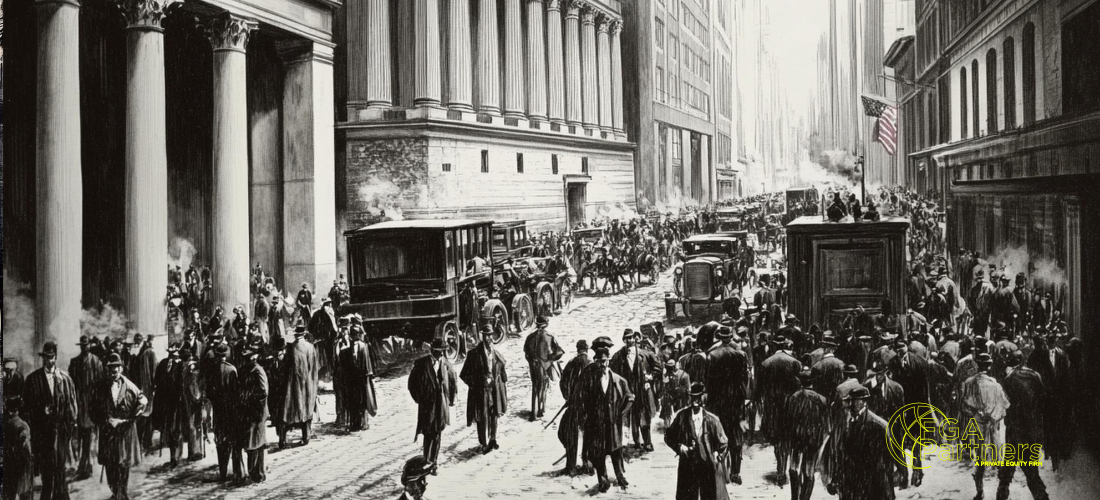
A second major wave occurred during the 1920s, a period characterized by rapid economic growth and financial experimentation leading up to the Wall Street Crash of 1929. During this era we had investment trusts and private lending syndicates that financed corporate expansion. Non-bank lenders provided capital to companies that could not easily access public bond market and leveraged financing structures became increasingly common. Sound a bit familiar?
When the financial system unraveled during the crash of 1929 and the subsequent Great Depression, many of these private lending structures collapsed alongside traditional financial institutions, prompting sweeping regulatory reforms that reshaped U.S. banking.
Another notable example emerged during the leveraged buyout boom of the 1980s. This is the era that gave way to what many consider the real hey day of Wall Street. As financial engineering advanced, institutional investors began allocating capital to private lending vehicles that supported corporate acquisitions.
During this period firms such as Kohlberg Kravis Roberts pioneered large-scale leveraged buyouts funded partly through private debt structures. Henry Kravis along with George Roberts paved the way which also led to the rise of Steve Schwarzman during that era.
High-yield bonds, popularized by figures such as Michael Milken, provided alternative financing channels for companies outside traditional bank lending. Institutional investors, including pension funds and insurance companies, began participating in private lending strategies. This was highly attractive due to the high volume of business and fees involved, it’s not different than what drives firms today.
The era produced landmark transactions, including the 1989 leveraged buyout of RJR Nabisco, which became one of the largest corporate buyouts in history for a very long time and a defining moment in the evolution of modern private credit markets.
The most recent and perhaps most significant expansion of private credit followed the 2008 Financial Crisis. In response to systemic risk revealed during the crisis, regulators introduced sweeping reforms designed to strengthen the banking sector.
Key regulations included the Dodd-Frank Act in the United States and International capital requirements established under Basel III. While these regulations improved bank balance sheet resilience, they also constrained traditional banks’ willingness to extend certain types of loans, particularly to middle-market companies and highly leveraged borrowers.
Into this vacuum stepped private credit funds, where they have their place in the markets but there needs to be some type of guard rails, maybe not government related but in general firm by firm.
Asset managers such as Blackstone, Apollo Global Management, and Ares Management began raising large pools of capital dedicated specifically to direct lending strategies. Institutional investors including pension funds, endowments and sovereign wealth funds allocated billions to these strategies in search of yield in a low-interest-rate environment. By the early 2020s, private credit had grown into a market estimated to exceed $1.5 trillion in global assets.
History shows that private credit expansions tend to occur when three conditions converge:
Bank Lending Constraints
When regulatory pressure or economic conditions restrict bank lending, alternative lenders emerge to fill the gap.
Institutional Capital Seeking Yield
Periods of low interest rates encourage large investors to pursue higher-yielding credit strategies outside public bond markets.
Corporate Demand for Flexible Financing
Companies—particularly middle-market firms and acquisition targets—often require financing structures that traditional banks cannot easily provide.
These conditions have appeared repeatedly throughout financial history, making the current private credit boom part of a broader cyclical pattern rather than a completely new phenomenon.
The Next Evolution of Private Credit
While the underlying dynamics are familiar, today’s private credit markets are evolving with new technological and structural innovations. Digital asset infrastructure, tokenized credit instruments and blockchain-based settlement mechanisms are beginning to influence how private lending agreements are structured and distributed.
These developments could introduce greater transparency, liquidity and accessibility to what has historically been an opaque segment of financial markets. If history offers any lesson, it is that financial systems rarely move in straight lines. Innovations in credit markets often emerge in response to regulatory change, economic stress or technological advancement.
The current expansion of private credit may feel unprecedented in scale, but its roots trace back through centuries of financial evolution, a reminder that while financial instruments change, the fundamental forces that drive capital formation remain remarkably consistent.